The Board Game Tracker Printable (For People Who Take Game Night Seriously)

Because “I swear I won last time” is not data.
“You always win that game.”
My husband says this with confidence.
I don’t argue. I open the tracker.
Two seconds later, I turn the screen around.
“Actually,” I say, “that’s not true. You do.”
And this—this right here—is why a board game tracker printable exists.
Not because we’re dramatic.
Not because we’re obsessive.
(Okay, maybe a little.)
But because “I never win this game” should be a verifiable lie.
Some people play board games.
Some people play them… and keep the receipts.
If you’re mildly competitive, data-curious, and the kind of person who wants to remember house rules three months later—Board Game Trackers are absolutely your thing.
Not sure what a board game tracker printable even is? Welcome. You’re about to ascend.
A board game tracker printable is a structured way to track board game wins, record play history, track expansions, rate games, and organize your collection—without relying on memory, vibes, or random notebook scribbles.
Whether you play casually with family or run full-blown competitive campaigns, tracking your games turns “I think” into “I know.”
(Want to learn more about hobby tracking? Read about how I actually use tracking in real life here—whether we’re talking board games, video games, TV shows, movies, reading, or other hella fun stuff.)
Why People Who Take Game Night Seriously Start Tracking Their Games
1. To Track Wins (And Settle Rivalries)
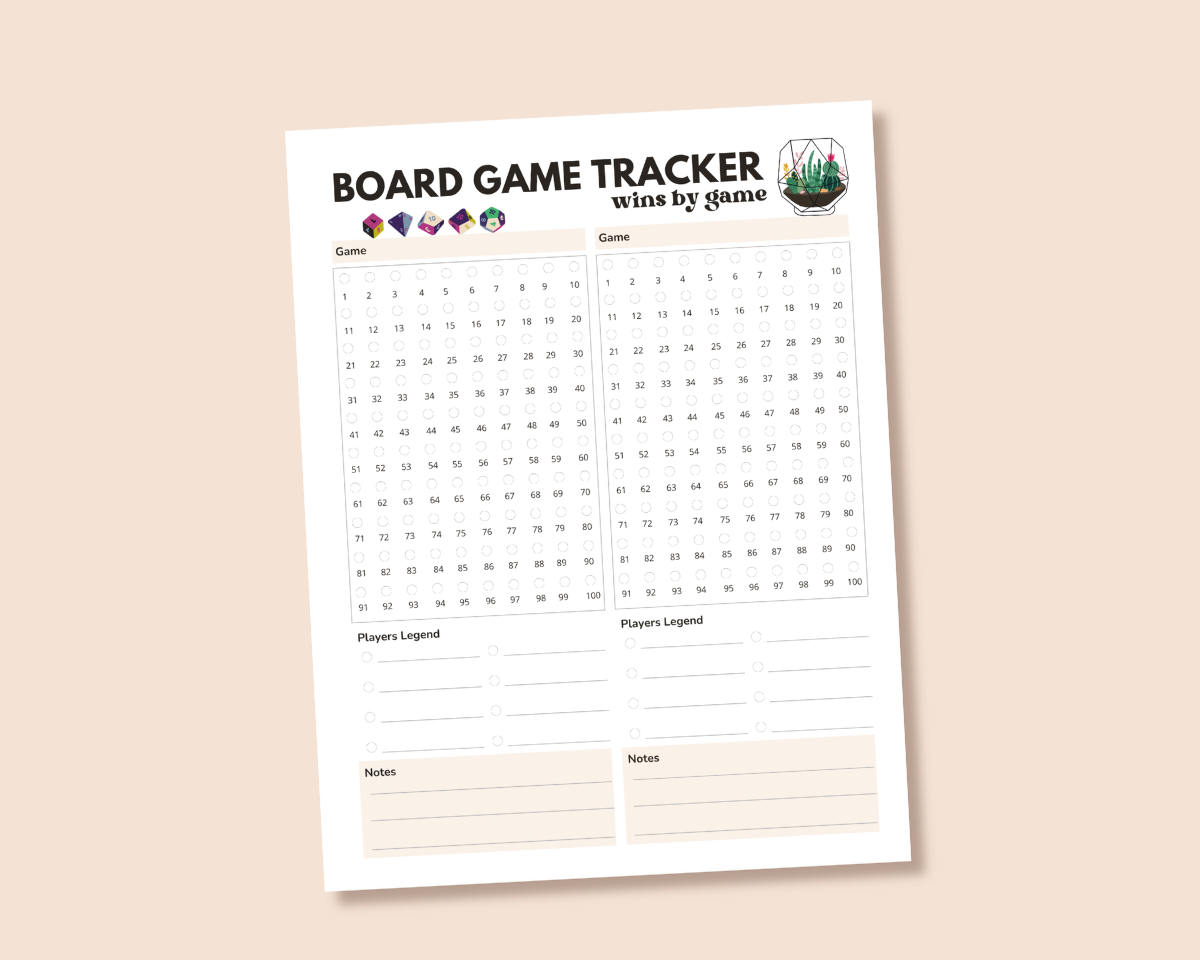
First and foremost: wins.
If you’ve ever argued about who actually dominates at Catan, Dune: Imperium, or Azul, you already understand the need for documentation.
Tracking wins isn’t about ego.
(Okay. Sometimes it’s about ego.)
It’s about accuracy.
Over time, patterns emerge:
Who consistently wins certain mechanics
Which games favor specific players
How expansions shift outcomes
Whether “I always lose this game” is actually true
Or whether you do, in fact, wipe the floor with deckbuilders
There is something deeply satisfying about discovering:
“Oh. I don’t just feel good at this game. I am good at this game.”
A proper board game tracker printable turns rivalry into data—and data into receipts.
2. To Track Expansions (Without Forgetting What You Own)
Winning is only part of it.
If you’ve been in the hobby long enough, you know that no game stays static forever.
Expansions get added.
House rules get invented.
Legacy campaigns permanently alter mechanics.
Someone insists on playing with a variant they found on Reddit in 2019.
And three months later, no one remembers what changed.
A board game tracker printable gives you a place to log:
Which expansions were used
What house rules were in play
Setup tweaks
Player counts
Notes about balance shifts
Because “Wait, did we use the Oceania expansion last time?” should not derail the first 20 minutes of game night.
Tracking these details keeps your table running smoothly—especially if you rotate through a large collection.
(And if you own hundreds of games? Documentation becomes self-defense.)
🎲 Not sure you’re ready for full statistical domination?
Start with the free sampler and see how it feels at your table.
3. To See What Actually Gets Played (And What Just Sits on the Shelf)
If you have a large board game collection (hi, same), here’s an uncomfortable question:
Which games actually make it to the table?
Not the ones you researched for three weeks.
Not the ones with the gorgeous box art.
Not the Kickstarter you defended in a group chat.
The ones you actually play.
A board game tracker printable will quietly expose you.
It reveals things like:
You own 400 games… and rotate the same 12.
You say you love heavy euros, but somehow Azul keeps coming back out.
That “9/10 masterpiece” hasn’t been touched since 2023.
The game you impulse-bought at Barnes & Noble has somehow dominated the year.
And listen—this isn’t about shame.
It’s about clarity.
When you track play frequency, patterns emerge. You see:
Seasonal favorites
Games that thrive at 2 players vs 5
The ones that always stall at setup
The ones that magically hit the table when certain friends come over
Instead of relying on memory (“we play that all the time, right?”), you have actual data.
Which is deeply satisfying.
Especially if you’re the kind of person who enjoys reorganizing a shelf just to see the vibes improve.
(And if your tracking tendencies extend beyond board games, there’s an entire tracker collection waiting for you.)
4. To Organize Your Board Game Collection (Without a Spreadsheet Ruining the Vibe)
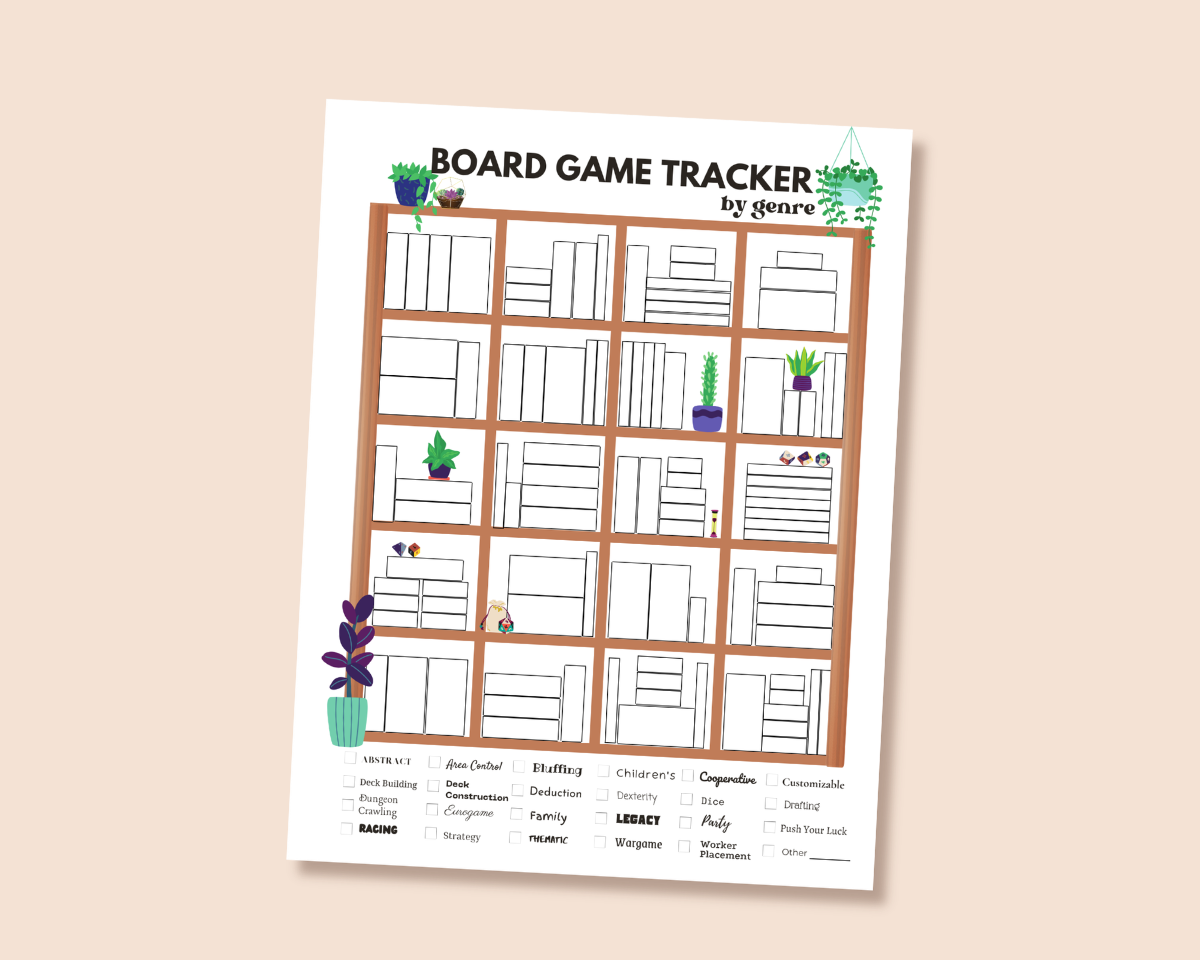
If your collection has passed the “fits neatly on one shelf” stage and graduated to the very adult IKEA Kallax era—you know, the cube wall, the commitment, the quiet understanding that this is your personality now—organization stops being cute and starts being necessary.
When you own dozens—or hundreds—of games, questions pile up:
What do we actually own?
What’s still in shrink wrap?
What did we loan out to Chris in 2022?
Why do we have two copies of the same expansion?
A board game tracker printable gives your collection structure.
Instead of relying on memory (bold strategy), you have:
Owned / Borrowed / Wishlist pages
Play frequency visibility
Ratings next to titles
Space for genre categorization
Which means when someone asks, “What should we play tonight?” you’re not scanning shelves in mild panic.
You’re consulting your system.
(Or at least pretending to. It still feels powerful.)
5. To Track Ratings & Strategy (And Watch Your Taste Evolve)
Wins tell you who dominated.
Ratings tell you who you are.
And sometimes? Who you used to be.
One of the most fascinating parts of tracking your games is revisiting your own opinions.
You flip back and see:
“Wait. I rated that a 6?”
Or worse:
“Why did I give this a 9?”
Over time, your tracker becomes a record of:
Strategy breakthroughs
Favorite player counts
“Only good with the expansion” notes
“Never again at 6 players” warnings
And the slow realization that yes, you absolutely dominate at deckbuilders
(You always suspected. Now you have proof.)
A board game tracker printable doesn’t just log wins.
It captures who you were when you swore Ark Nova was your personality… and who you actually are when Heat: Pedal to the Metal somehow gets played three times in one night.
The mechanics you gravitate toward.
The themes that stick.
The complexity ceiling your group actually enjoys.
It turns “I think I love this game” into “We’ve played this 14 times, and I rated it 8+ every single time.”
That’s a different kind of confidence.
6. To Turn “I Think” Into “I Know” (Because Actual Data Rocks)
There’s a specific kind of person who says:
“I think I won that.”
And another kind who calmly replies:
“Give me a second.”
scrolls
“Nope.”
A board game tracker printable is not about being intense.
It’s about being certain.
It’s the difference between:
“I feel like we play this one a lot”
And “We’ve played it 17 times since October.”
“I never win at this.”
And “You’ve won 63% of the time, actually.”
“That expansion makes it unbalanced.”
And “The data suggests you just lost.”
Tracking your games removes the fuzziness.
It replaces vague memories with numbers, vibes with patterns, and table arguments with receipts.
And weirdly?
It makes game night more relaxed.
Because once the stats exist, you don’t have to defend your memory. You don’t have to guess. You don’t have to replay arguments from three months ago.
You just play.
(And occasionally, gently rotate the iPad toward your spouse when necessary.)
A board game tracker printable doesn’t make you competitive.
It just makes you accurate.
Which, if we’re honest, is sometimes even better.
Not All “Board Game Trackers” Are Actually Tracking Anything
A solid board game tracker shouldn’t feel like data entry. It should feel like part of the game.
Some are glorified score sheets.
Some are a single page with a grid.
Some are… optimistic.
If you’re going to track your games, you want something that can actually handle:
Large collections
Repeat plays
Multiple player counts
Expansions
Ratings
House rules
Strategy notes
The occasional mildly feral rivalry
If you’re going to commit to tracking your games, don’t settle for something that’s basically just keeping score.
Win Tracking Grids
So you can see patterns at a glance (and yes, confirm deckbuilder dominance).
Play Logs
For recording date, player count, expansions used, and outcome.
Collection Status Pages
Owned. Borrowed. Wishlist. (Because let’s be honest, all three are active categories.)
Rating & Review Sections
So your opinions live somewhere other than your brain.
Strategy & Notes Pages
For future-you. The wiser, better-prepared version of you.
And ideally?
It should work both printed at the table and digitally on a tablet.
Because some of us like paper.
And some of us like searchable evidence.
So yes. You have options.
You could keep notes in a random notebook.
You could build a spreadsheet.
You could rely on memory.
(Bold.)
Or—
You could use a board game tracker printable that was actually designed for people who take game night seriously.
Which brings us to:
Board Game Trackers
(For people who take their game night seriously.)
Not a single-page score sheet.
Not a glorified checklist.
A system.
Why These Trackers Are Built Differently
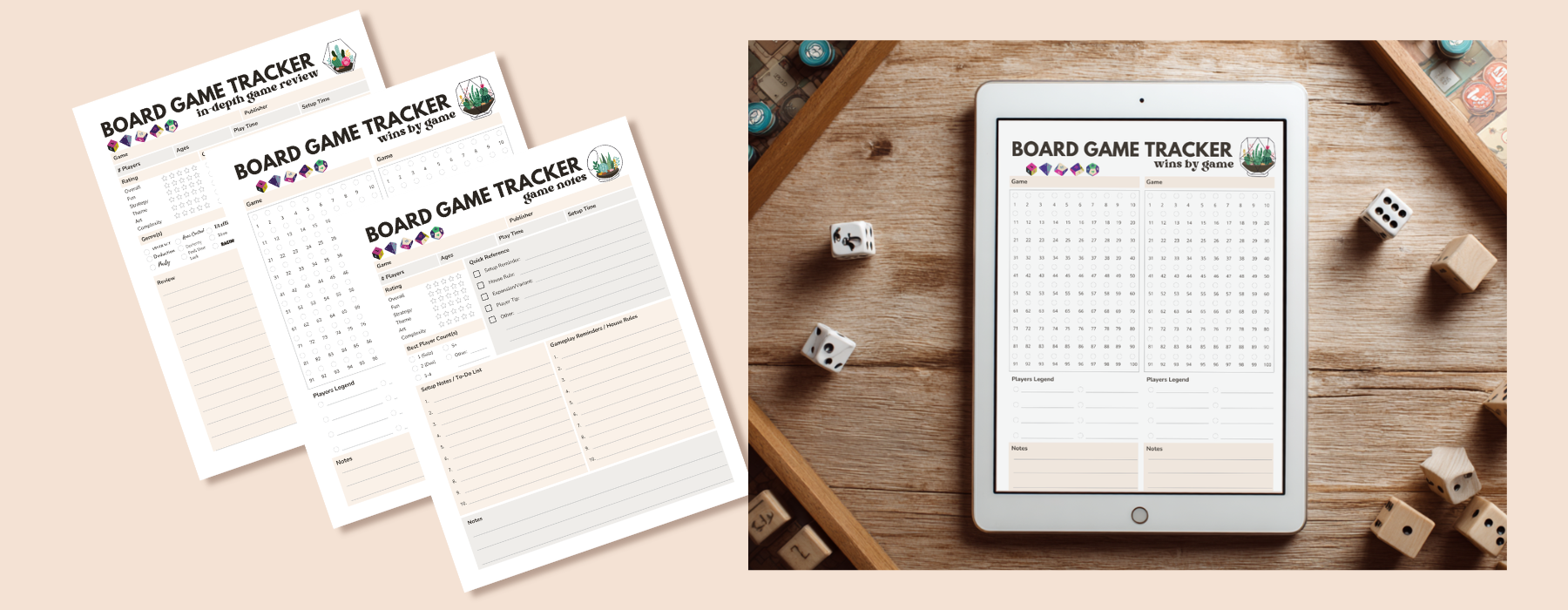
More than a basic score sheet, these Board Game Trackers hook you up with things like:
Dedicated win-tracking grids so patterns show up fast
Detailed play logs for date, player count, expansions, and outcomes
Collection status pages (Owned / Borrowed / Wishlist—because all three absolutely exist)
Genre categorization for spotting your mechanical biases
Rating + review pages so your opinions don’t evaporate
Strategy notes for future-you (who will absolutely forget otherwise)
They work printed at the table.
They work digitally on a tablet.
They scale whether you own 12 games or 400.
And most importantly?
They replace guesswork with receipts.
Track wins. Log plays. Settle debates. Repeat.
If you’re the kind of person who:
Wants to see patterns
Enjoys knowing the stats
Secretly loves confirming dominance
Or just wants your IKEA Kallax era to feel organized
This was built for you.
The Board Game Trackers are ready whenever you are.
Because “I think I usually win this game” is a terrible statistic.
Other Things You Might Be Wondering
-
Extremely.
If you know someone who:
Hosts game night
Alphabetizes their collection
Says things like “we should track that” without irony
…this is a top-tier gift.
It’s practical. It’s slightly nerdy. It feels thoughtful without being “I panicked at checkout.”
Especially perfect for someone deep in their IKEA Kallax era.
Bonus: it doesn’t require shelf space.
Double bonus: it fuels their competitive tendencies in a socially acceptable way.
-
Yes.
Catan. Wingspan. Earth. Brass: Birmingham. Flamecraft. The latest Dominion expansion. That one obscure Kickstarter you waited 18 months for.
This board game tracker printable is game-agnostic.
It’s built to log:
Wins
Expansions
Ratings
Notes
Patterns
Mild grudges
From light party games to heavy campaign monsters.
If you can play it, you can document it.
-
Not at all.
Some people use it to track world domination.
Some use it to record memories.
Some want to know which games actually come back to the table.
Some want proof that “I never win this game” is, in fact, a verifiable lie.It scales from cozy family night to full statistical analysis.
You choose your intensity level.
We do not judge.
(We do provide the grids.)
-
Both.
Print it and keep it at the table.
Slip it into a binder.
Clip it to a clipboard like the beautiful organized gremlin you are.Or use it digitally on your tablet.
Structured chaos. Your way.
-
Not even close.
It works whether you’re in your:
“fits neatly on one shelf” era
“small but mighty collection” phase
or full cube-wall lifestyle
The system scales with you.
Today it’s five games.
Tomorrow it’s 47.
We don’t ask questions. -
Short answer? Yes.
Long answer? Depends what you mean by “free.”
If you want a basic one-page score sheet, those exist online.
But if you want to actually feel how this system works at the table—the structure, the flow, the “ohhh this is satisfying” moment—we made something for you.
👉🏼 Play It Cool is a free sampler pack.
It gives you a taste of the tracking magic without unlocking the entire vault.
Log a few games. Pull it out mid-argument. See how it hits.
Then, when you’re ready for the full win grids, collection tracking, expansion logging, rating systems, and mildly feral domination charts?
You’ll know.
(And you’ll want receipts.)
-
You absolutely can.
You can also track your workouts on a napkin or plan your wedding in Notes app.
Spreadsheets are powerful.
They are not cozy.
They are not built for passing around the table mid-game while someone is dramatically claiming they “never win.”A dedicated board game tracker printable is designed for:
Quick logging between turns
Visual pattern spotting
At-a-glance domination evidence
Actual human use at a table with snacks
It’s structured for gameplay, not cell formatting.
If you love spreadsheets, rock on.
If you want something that feels like part of game night instead of a quarterly earnings report?
That’s what this is for.