We Own 400+ Board Games—Here’s What Actually Gets Played (And Why)
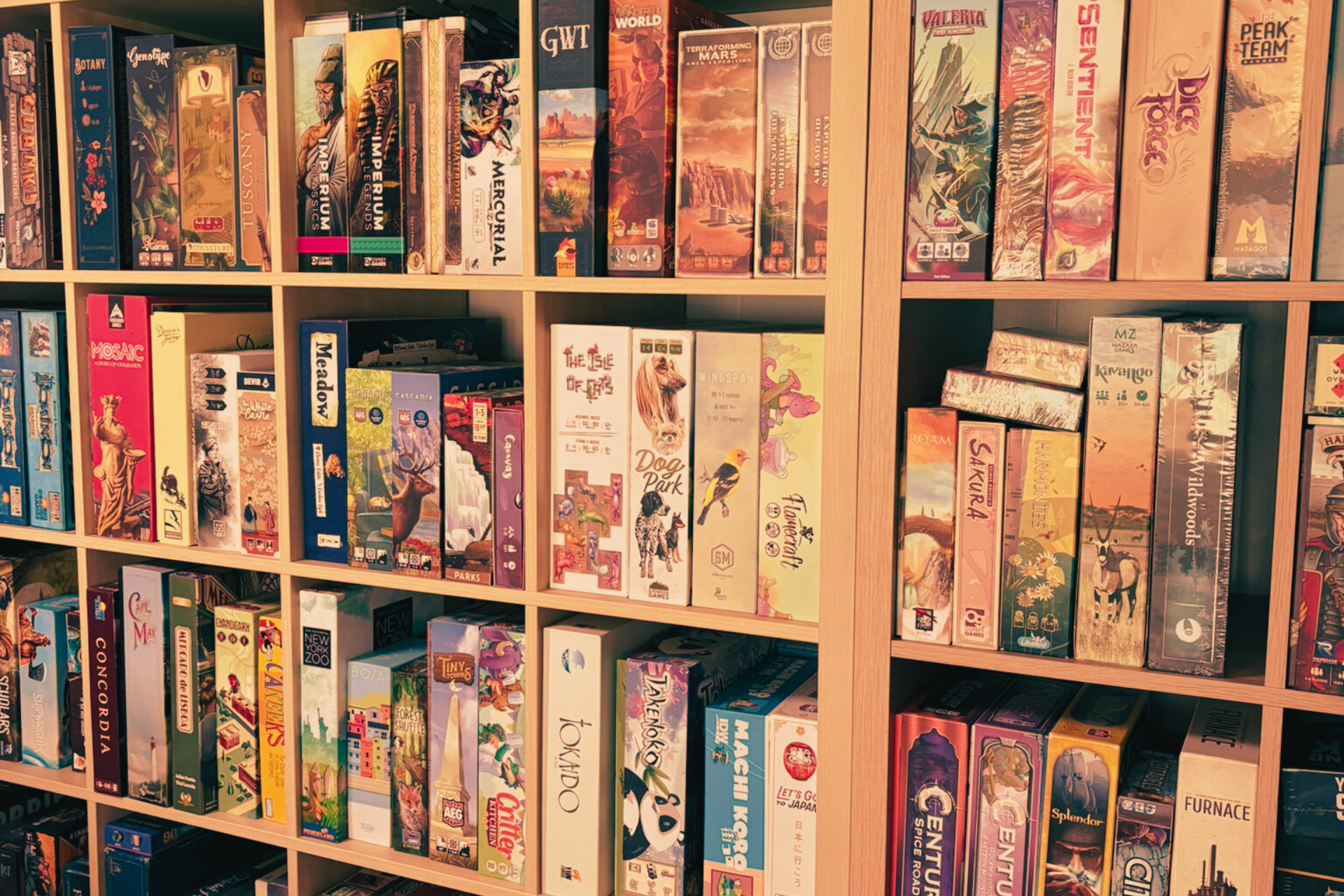
There’s something I need to admit, and I don’t love it—but it’s true.
Owning board games and playing board games are not the same hobby.
I would also prefer if this were not the case, given my current Kallax situation. At last count, I’ve got at least a dozen games still in the shrink wrap… and yet I recently had the audacity to take home a copy of Vantage like I don’t already have enough going on. I should probably be telling my therapist about this, not you, but here we are.
And unfortunately, this is not a board-game-specific issue. I do it with books. I used to do it with Blu-rays before streaming saved me from myself. I’ve even done it with crafting supplies—the yarn, the watercolor sets, the double-tip markers, the stick-on felt in rainbow colors, the very specific glue that convinces you you’re about to become a person with strong opinions about glue.
And then… you don’t actually make the thing.
Not because you’re lazy. Not because you did anything wrong. But because buying the supplies and doing the hobby turn out to be two completely different activities.
Ask me how I know.
We own more than 400 board games. Which sounds impressive until you realize we do not, in fact, play 400 board games. Not even close. And it’s not because we don’t want to. It’s because actually playing a board game, in real life, is kind of… a production.
You have to decide to do it. You have to stop whatever else you’re doing. You have to go into another room, pick something, set it up, maybe relearn the rules, maybe teach the rules, and then actually sit there long enough to play it. (Note to self: I also need more comfortable chairs.) Which is delightful when it happens—but it’s not exactly a casual, five-minute activity you can squeeze in between everything else.
And that’s where things start to diverge.
Because the version of me who buys games? Thriving. Absolutely thriving.
She’s researching, watching playthroughs, reading reviews like it’s investigative journalism, comparing mechanics, debating player counts, and confidently adding things to cart like she has a full, uninterrupted Saturday waiting for her. She is building a collection. She has taste. She has a very clear vision of the kind of cozy, immersive, slightly competitive game days she is absolutely going to have.
The version of me who actually plays those games is… dealing with reality.
She still loves games. She still gets genuinely excited about opening a new one, punching out the pieces, learning the system, and stepping into a new little cardboard world. That part? Still undefeated.
But she also has a house, a kid, a schedule, and a brain that occasionally just wants something easy instead of orchestrating a whole event.
So the issue isn’t that I only want to play the same familiar games. If anything, I’m almost more interested in the new ones. The issue is that both familiar games and new games require time, energy, and a certain kind of “let’s do this” momentum—and that doesn’t always show up when you want it to.
Meanwhile, buying a game takes about four minutes and a strong sense of optimism.
That’s the gap.
Not collector vs player, exactly—but collector vs real life, with a very optimistic version of “future me” acting as the bridge between them.
And once you notice that, a lot of things start to make sense.
You start seeing the games you were genuinely excited about that never quite made it to the table. The “this will be perfect for game night” picks that somehow never got picked. The shrink-wrapped boxes that feel less like clutter and more like a list of very good intentions.
In my head, for example, I was convinced my husband and I had a big game stretch back in January. Like, vivid memory. Cozy nights, multiple plays, the whole thing.
According to my tracker, the last time we had a stretch like that was August.
August.
Which is… humbling.
That’s the moment where “I think” quietly collapses under the weight of “oh.”
(This is the same type of moment I talked about inI Thought I Knew Who Won Game Night. I Was Wrong.)
And this is where tracking actually becomes interesting—not in a hyper-optimized, spreadsheet way, but in a “what is actually happening here?” way.
Because once you start writing things down, patterns show up fast. You see what actually gets played, what gets talked about more than it gets used, which games require too much setup to be a weeknight option, and which ones somehow slip into rotation without effort. You start to see your real habits instead of your imagined ones.
And that’s useful.
Not because it means you need to stop buying games. Absolutely not. Buying games is fun. Researching them is fun. Having a collection that reflects your taste is fun. The collecting part is a real, valid part of the hobby.
But there’s something genuinely clarifying about seeing the difference between what you love the idea of and what your actual life supports right now.
Sometimes that means you buy a little more intentionally. Sometimes it means you make a point to pull out something that’s been sitting there untouched. Sometimes it just means you stop feeling vaguely guilty about the gap, because now you understand why it exists.
And sometimes it just means you fully accept that, yes, you have two related but very different hobbies sitting on the same shelf—and you enjoy both of them for what they are.
If you’re even a little curious what your own “we play this all the time” actually looks like in reality, that’s where tracking comes in. Not to optimize anything or turn game night into homework—just to keep receipts.
Because “I think” is fine.
But “I know” hits different.
If you’d like to gently fact-check your own memory (highly recommend), the Play It Cool sampler is a very non-intimidating way to start.
No spreadsheets. No pressure. Just receipts.